
CPT Rigs
CPT rigs for cone penetration testing, pushing an instrumented cone to record tip resistance, sleeve friction and pore pressure in situ. The range covers boxed and compact crawler systems from 100 to 200 kN. Supplied, supported and serviced in the UK.
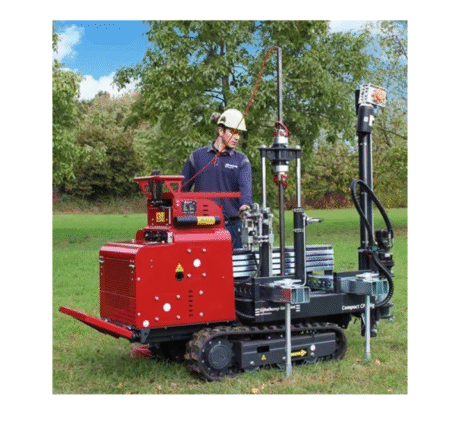
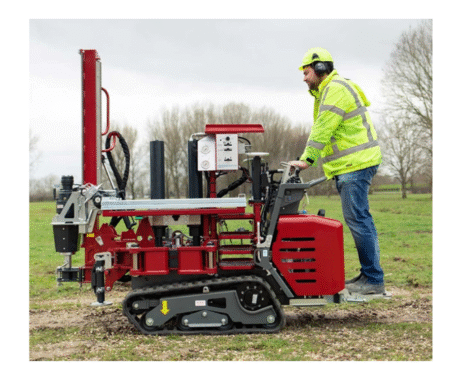


The CPT range
- Boxed Crawler CPT 100 — 100 kN enclosed crawler unit, the entry point to the range.
- Compact Crawler CPT C 130 — 130 kN in a compact tracked form, for sites where access rules out a larger machine.
- Compact Crawler CPT 200 — full 200 kN capacity in a compact crawler configuration.
- Boxed Truck Crawler CPT 180 — 180 kN with truck mobility and an enclosed working environment.
- Boxed Truck Crawler CPT 200 — the highest capacity unit in the range, truck mounted and boxed.
What CPT gives you that drilling does not
A CPT push produces a continuous, high resolution record of what the ground is doing with depth — tip resistance, sleeve friction, and with a piezocone, pore water pressure. From those you derive soil behaviour type, relative density, undrained shear strength and the parameters a geotechnical design actually needs.
Drilling gives you material. If the question is what the ground is made of, or what is chemically present in it, you have to recover a sample. If the question is how the ground will behave under load, CPT answers it directly and continuously, where a borehole would give you readings at sample intervals and require laboratory testing on samples that have been disturbed in transit. It is faster, cheaper per metre of information, and available the same day.
The two are complementary rather than competing, and a well designed investigation frequently uses CPT for the parameter profile and a smaller number of boreholes for material and chemistry.
Capacity, reaction and refusal
The kN figure is the thrust the machine can apply. Greater thrust reaches deeper and penetrates denser material before refusal, but capacity is only useful if the rig can react against it — that reaction comes from the machine's own mass and, where required, from ground anchors.
Refusal is a fact of CPT rather than a fault. Dense gravels, cobbles, obstructions in made ground and rockhead will stop a push, and forcing it risks damaging the cone. On sites with shallow obstructions the standard approach is to pre-drill through the obstruction and resume, which is worth planning for at the outset on brownfield ground.
Boxed or compact
Boxed units enclose the working area, which keeps the crew and the electronics out of the weather. Given that a CPT push is a slow, continuous operation the operator monitors throughout, that is a productivity consideration in a British winter rather than a luxury. Compact crawlers trade the enclosure for access, and on constrained urban sites that trade is often forced.
Related ranges
Where you need material rather than parameters, see Sonic Rigs for high recovery coring in difficult ground and Conventional Rotary Rigs for general drilling. For shallow investigation with restricted access see Window Sampling, which also includes penetrometer equipment. For hand-operated investigation tools see Soil and Water.
CPT rig FAQs
Specifying a rig
CPT systems are configured to the programme and quoted rather than listed. Tell us the depths you need to reach, the ground you expect, whether pore pressure measurement is required and what your site access allows, and we will match a machine to it. Request a quote, ask about the UK rental fleet, or read about service and support.