
Groundwater Pumps
Eijkelkamp groundwater pumps for purging, sampling and well development — submersible, peristaltic, hand operated foot valve and engine driven pumps, with flow through cells, in-line filter holders and tube dispensers for low-flow sampling.




Submersible pumps
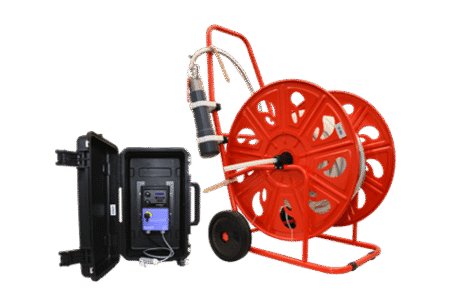
- Gigant Submersible Pump — the capable unit for regular purging rounds, deeper wells and larger volumes.
- MP1 Submersible Pump — compact submersible for purging and sampling in monitoring wells.
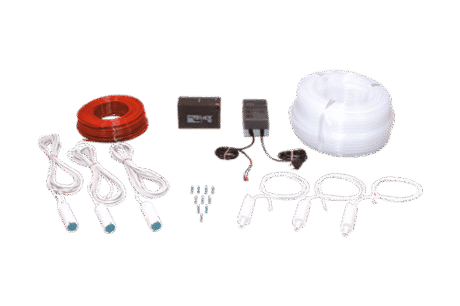
- Submersible Pump Set — Low Cost — lighter duty, for occasional sampling or as a backup so one failure does not stop a round.
Peristaltic and manual pumps
- Peristaltic Pump ROYAL — powered peristaltic pumping for shallow water tables, with only the tubing contacting the sample.
- Peristaltic Pump — Hand Operated — the same principle without a power source.
- Hand Operated Foot Valve Pump Set — slow and manual, but it works on remote wells where carrying power is impractical.
- Water Pump with Combustion Engine — for moving volume: well development, dewatering and heavy purging.
Field measurement and filtration
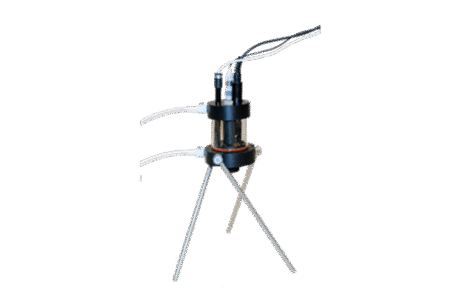
- Flow Through Cell Compact — measure pH, conductivity, dissolved oxygen and temperature in the pumped stream without exposing it to air.
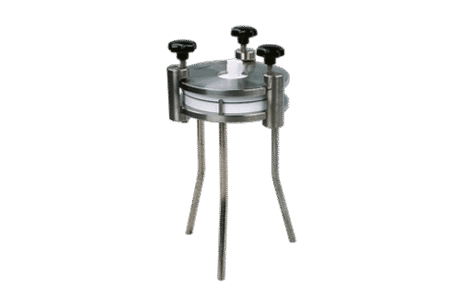
- Filter Holder for In-Line Filtration — filter in the line for dissolved fraction analysis, avoiding air contact and post-collection handling.
- Tube Dispenser — for handling and deploying tubing cleanly on multi-well rounds.
Choosing between submersible and peristaltic
Depth settles it in most cases. A peristaltic pump draws water up by suction from the surface, and suction lift has a hard physical limit — below a certain water table depth it simply will not work. A submersible pump sits in the water and pushes, so depth is not the constraint.
Where the water table is shallow enough that either would work, peristaltic is often the better choice for contaminated land sampling. Only the tubing contacts the sample, so decontamination between wells means fitting fresh tube rather than cleaning a pump body that has been sitting in contaminated groundwater. That is faster, cheaper and considerably easier to defend in a report.
Low-flow sampling in practice
Pumping hard is the fastest way to get a sample you cannot rely on. High rates draw water in from outside the screened interval, mixing horizons you carefully kept separate at installation, and they mobilise fines that turn up as turbidity and as elevated total metals.
Low-flow purging draws gently and watches field parameters through a flow through cell until they stabilise, at which point the water entering the pump is formation water. The samples are cleaner, more representative, and there is far less purge water — which on a contaminated site is a disposal cost avoided rather than merely an inconvenience.
Related equipment
See Liquid Samplers where the method calls for a bailer or a discrete depth sample rather than a pumped one, Consumables for tubing, valves and in-line filters, and Monitoring Wells for the wells themselves — remembering that the pump, not the meter, sets the minimum well diameter. Popular pumps are also available for immediate ordering in the shop.
Groundwater pump FAQs
Ordering and support
All pumps here are genuine Eijkelkamp equipment supplied direct from our UK operation. Tell us your well diameter, typical depth to water, the determinands you are sampling for and whether you work to a low-flow protocol, and we will specify the right pump and ancillaries. Request a quote or get in touch.