
Liquid Samplers
Eijkelkamp liquid samplers for groundwater, surface water and soil pore water — bailers, Van Dorn and Kemmerer discrete depth samplers, watertrap samplers, rod and cable operated liquid layer samplers, and Rhizon soil moisture samplers.



Groundwater and well sampling
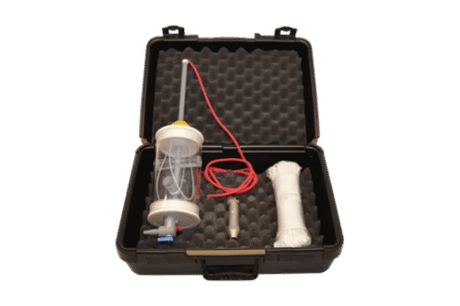
- Bailer Sampler — the simple, powerless option for a single sample from a well. Fast to deploy, with the caveats below.
- Watertrap Water Sampler — captures water at a defined point and retains it during retrieval.
Discrete depth samplers
- Van Dorn Water Sampler Set — horizontal messenger-triggered sampler, for taking a thin layer without mixing across it.
- Kemmerer Water Sampler Set — vertical messenger-triggered sampler, the traditional choice for general limnological work.
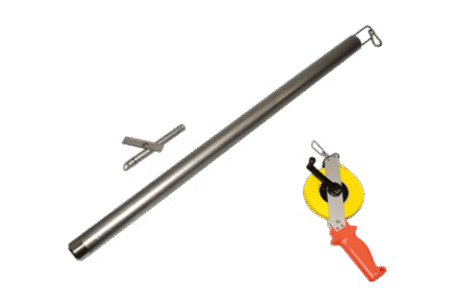
- Liquid Layer Sampler — Rod Operated — positive depth control for shallow stratified liquids and layered contamination.
- Liquid Layer Sampler — Cable Operated — the same principle with far greater reach.
Soil pore water
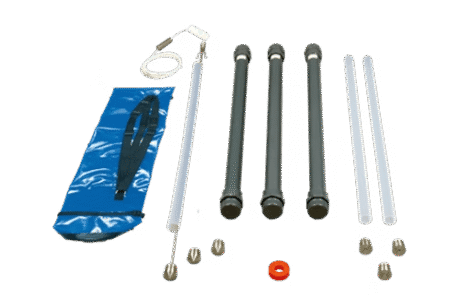
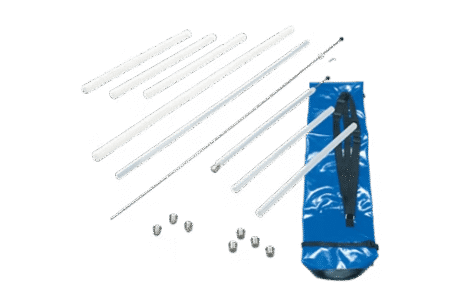
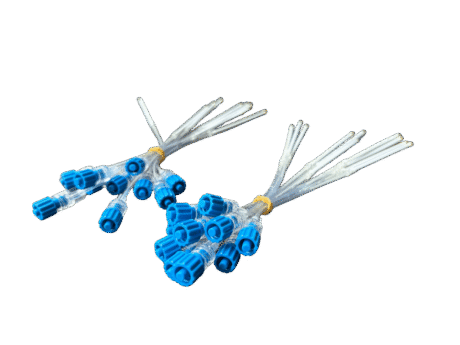
- Rhizon Soil Moisture Sampler and the complete sampling set — extract soil solution in place with minimal disturbance, and sample the same point repeatedly.
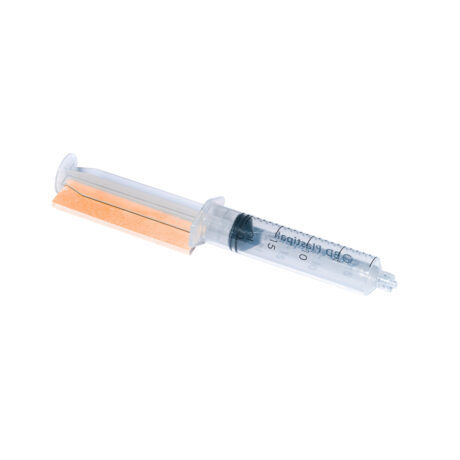
- Plastic Syringe for MacroRhizon — the consumable part of the arrangement.
Why depth control matters
Water is rarely uniform with depth. Lakes and reservoirs stratify thermally, estuaries stratify by salinity, and contaminated groundwater often has a layer of product sitting on the water table. A sampler that fills on the way down gives you a mixture of everything it passed through, which describes none of those layers correctly.
Messenger-triggered samplers solve this. They are lowered open so water flows freely through them, then closed at the target depth by dropping a weight down the line. What comes back is water from that depth and nowhere else. Where the layer you care about is thin, a horizontal Van Dorn is better than a vertical sampler, which necessarily spans a greater vertical interval.
The honest case against bailers
Bailers are convenient, cheap and sometimes required by the method, and they remain the practical answer for narrow wells and sites with no power. But the act of retrieving one agitates the water and exposes it to air, and that changes dissolved oxygen, redox and volatile content before the sample reaches the bottle.
If your determinands include volatiles or dissolved gases, low-flow pumping with a pump and flow through cell will give a defensibly better sample. Where you do bail, lower and raise slowly, do not drop the bailer onto the water surface, and keep clear of sediment at the base of the well.
Related equipment
See Groundwater Pumps for purging and low-flow sampling, Sludge Samplers for bed sediment, Water for field meters, and Monitoring Wells for the wells. Rhizon samplers are also available for immediate ordering in the shop.
Liquid sampler FAQs
Ordering and support
All samplers here are genuine Eijkelkamp equipment supplied direct from our UK operation. Tell us what you are sampling, at what depth, whether the water is stratified and which determinands matter, and we will recommend the right sampler. Request a quote or get in touch.