
Window Sampling
Window sampling and dynamic probing equipment for shallow site investigation where access is restricted. The range covers the TEC11 EVO, the Tecop TPT27 drilling mast and the AMK TEC 03 penetrometer — compact enough to reach positions a rig cannot, and quick to mobilise for short visits.

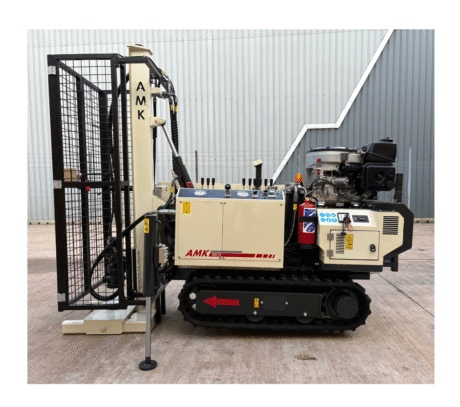

The range
- TEC11 EVO — window sampling rig for shallow investigation on constrained sites, recovering a near-continuous soil column for description and sub-sampling.
- Tecop Drilling Mast TPT27 — a compact drilling mast for shallow investigation and light drilling where a full size rig is impractical.
- Penetrometer AMK TEC 03 — dynamic probing equipment, driving a cone with a standardised falling weight and recording blow counts to profile ground resistance with depth.
How window sampling works
A slim steel sampling tube is driven into the ground by percussion. Along its length runs a long slot — the window — and when the tube is withdrawn the soil column inside can be seen, logged and sub-sampled directly through that opening, rather than having to extrude the whole core first.
The result is a near-continuous record of the upper few metres, recovered quickly and with very little disturbance to the site. Successive tubes are driven in the same hole to advance it, usually with a disposable liner in each so that samples can be capped and sent to the laboratory without transfer.
Access is the reason it exists
Most shallow investigation in the UK happens where building has already happened, and the position the engineer wants is frequently somewhere no rig can reach: a terraced back garden, an alleyway, a footpath beside a live road, a basement, the inside of an occupied warehouse. Window sampling equipment is sized for exactly those positions — compact, in some configurations low headroom, and able to be moved by hand where necessary.
It also mobilises fast. On a programme made up of many short visits to scattered addresses, the time saved not mobilising and demobilising a tracked rig is often the whole economic case for the method.
Sampling and probing together
Window sampling and dynamic probing answer different questions and are commonly used on the same job. Sampling recovers material — for description, classification and chemical analysis. Probing recovers no material at all, but gives a rapid, continuous profile of ground resistance with depth for very little cost per position.
The efficient pattern is to sample at the positions where you need material and probe between them to check that the ground is behaving as the sampled holes suggest. That gives far better spatial coverage than sampling alone within the same budget.
Where the method runs out
Window sampling is a shallow technique and it meets refusal. Dense granular material, cobbles, obstructions in made ground and rockhead will stop it, and no amount of additional driving changes that. Where the investigation needs to go deeper, through obstructions, or requires high recovery core in difficult ground, sonic rigs are the usual next step. Where the deliverable is in-situ geotechnical parameters rather than material, CPT is faster and cheaper. For general drilling see conventional rotary rigs.
For hand-operated investigation shallower still — soil description, agricultural survey, peat depth — see soil augers and soil sampling equipment.
Window sampling FAQs
Specifying equipment
This equipment is configured to the work and quoted rather than listed. Tell us the depths you need to reach, the ground you expect, the access at your typical sites and whether low headroom working is required, and we will recommend a specification. Request a quote, ask about the UK rental fleet, or read about service and support.