
Gouge Augers
Eijkelkamp gouge augers for near-undisturbed soil profiling. The range covers Pürckhauer sets, one-piece, two-piece and multi-piece sets for soft and hard soils, mineral and arable land gouges, top layer sets and stepwise sampling sets for recovering discrete samples by depth.
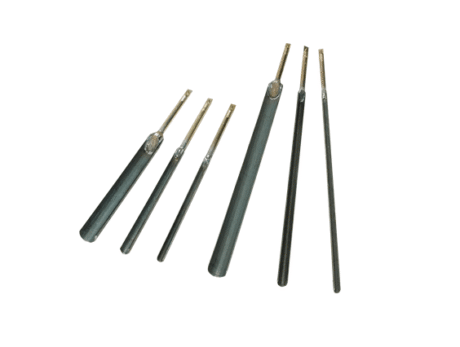

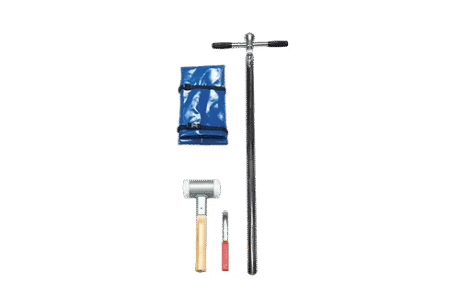
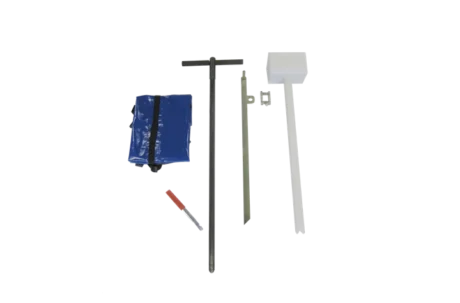
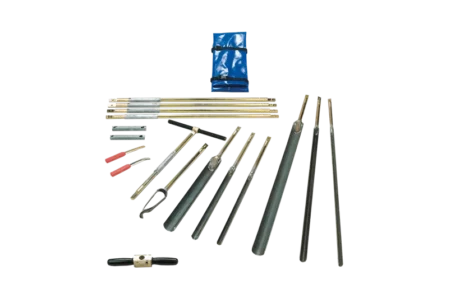

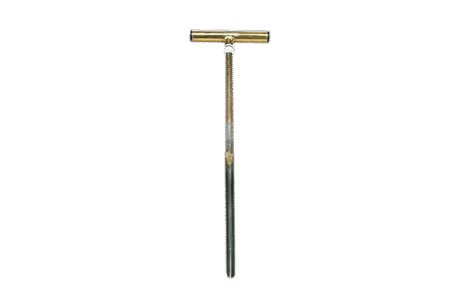

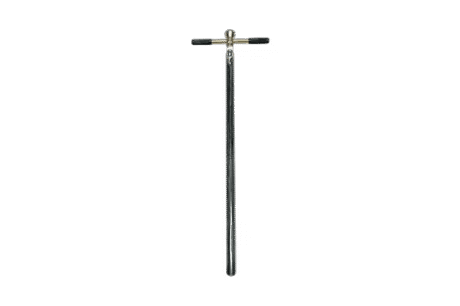


The complete gouge auger range
- Pürckhauer Gouge Auger Set — the classic soil survey gouge and the most widely used model for general profiling.
- One-Piece Set — Soft Soils and One-Piece Set — Hard Soils — no joint between gouge and extension, so nothing to loosen or shear under driving.
- Two-Piece Set — Soft Soils and Two-Piece Set — Hard Soils — separate for transport and storage.
- Single Gouge Auger — Soft Soils and Single Gouge Auger — Hard Soils — individual gouges to add to an existing set.
- Gouge Auger Set for Top Layers — shorter and lighter, for shallow profiling where the information is near the surface.
- Gouge Auger Set for Stepwise Sampling — discrete samples from successive depth intervals, kept separate with a known depth each.
- Mineral Gouge Auger — cut for denser mineral soils below the organic horizons.
- Auger for Arable Land — sized for agricultural topsoil and rooting zone work.
- Gouge Auger Bottom — the working tip and channel alone, for renewing a worn edge.
Choosing soft soils or hard soils
This is the decision that matters most, and it is decided by the ground rather than by preference. Hard soils gouges use reinforced geometry that resists deflection and edge damage in dry, compacted and stony material. Soft soils gouges are cut to release cohesive and saturated material cleanly instead of retaining it in the channel.
Use the wrong one and both failure modes are real: a soft soils gouge driven into hard ground damages its cutting edge, and a hard soils gouge in soft cohesive material gives poorer sample release and a messier profile to read. If your sites genuinely vary, carrying both is more economical than replacing damaged tips.
One-piece against two-piece
The joint between gouge and extension is the highest stress point in the assembly when the tool is being driven. One-piece construction removes it entirely, which is why it is the right choice for consistently hard ground. Two-piece and multi-piece sets break down for transport, storage and air travel, and the joint is under far less stress in soft ground where the tool is largely pushed rather than hammered. Depth requirement decides the rest: multi-piece sets extend furthest.
Reading the profile properly
The value of a gouge sample is in the sequence, and it is easily destroyed. Lay the gouge horizontally with the channel upward and describe the profile before disturbing anything — colour, texture, structure, horizon boundaries and how sharp they are. Photograph against a scale where the record matters. Only then take sub-samples, because once material has been scraped out the depth relationships are gone.
The soil colour book and sand ruler exist to make that description repeatable between surveyors, which matters as soon as more than one person is logging on a project.
What you need alongside
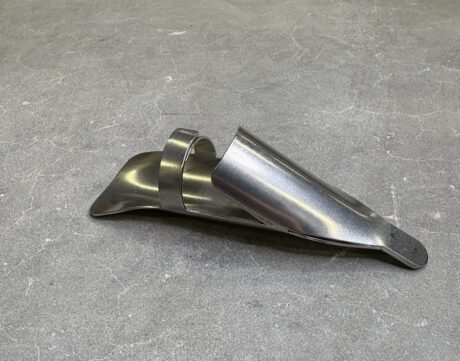
Gouges are driven rather than turned, so you need an auger handle with beathead and an impact absorbing hammer — never a standard cross handle. Add extension rods for depth, and a thumb spatula for clearing the channel between samples.
Related equipment
Where you need bulk material rather than a profile, see Hand Augers. For undisturbed samples for laboratory testing see Soil Samplers. Popular gouge models are also available for immediate online ordering in the shop.
Gouge auger FAQs
Ordering and support
All gouges here are genuine Eijkelkamp equipment supplied direct from our UK operation. Describe your ground conditions and the depths you need to profile, and we will confirm whether a soft or hard soils model, and one-piece or multi-piece construction, is right before you order. Request a quote or get in touch.